Test-Time Reinforcement Learning for Flow Matching
📦 Code is available at https://github.com/TheShy-Dream/Flow-TTRL
📄 Paper coming soon.
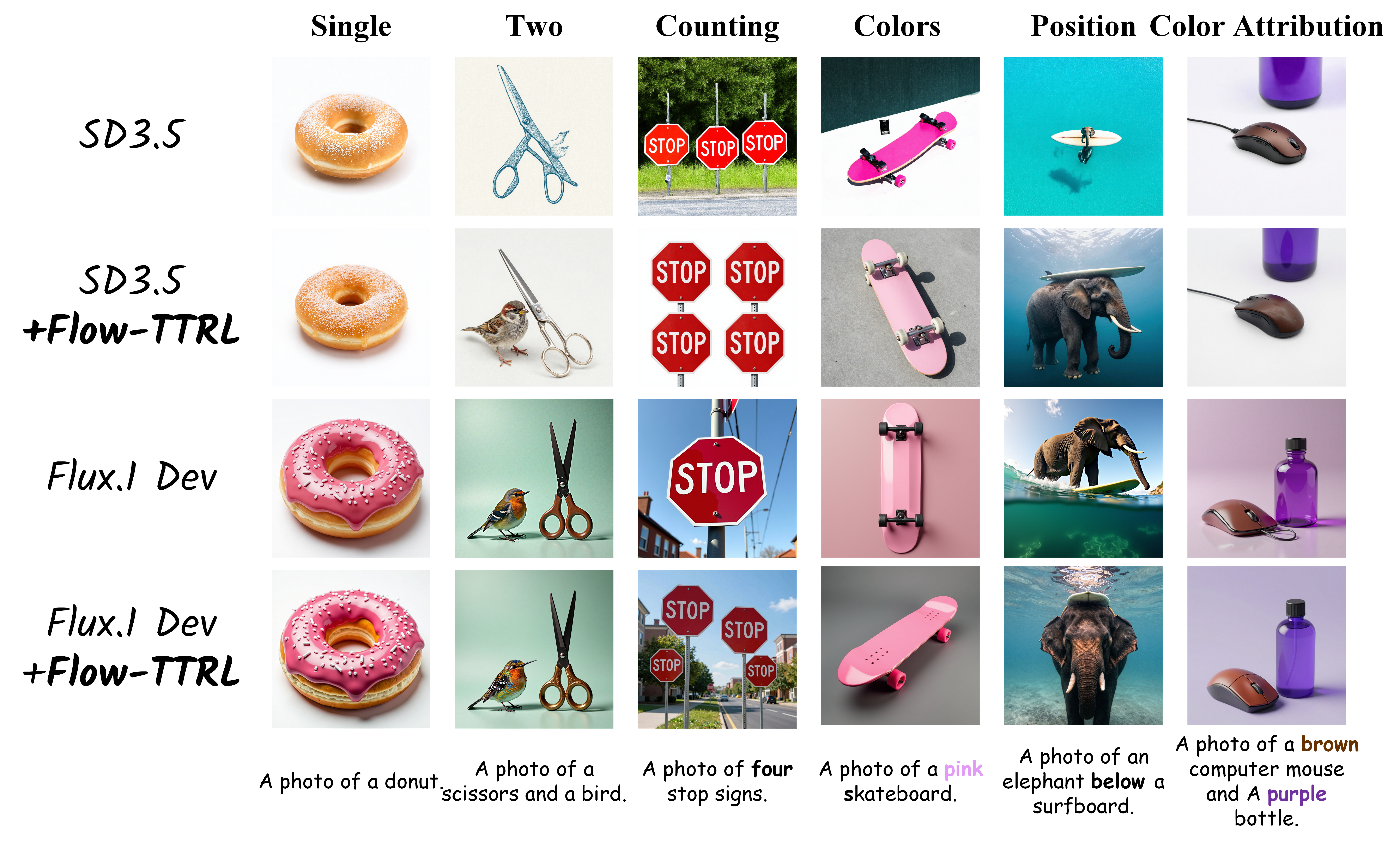
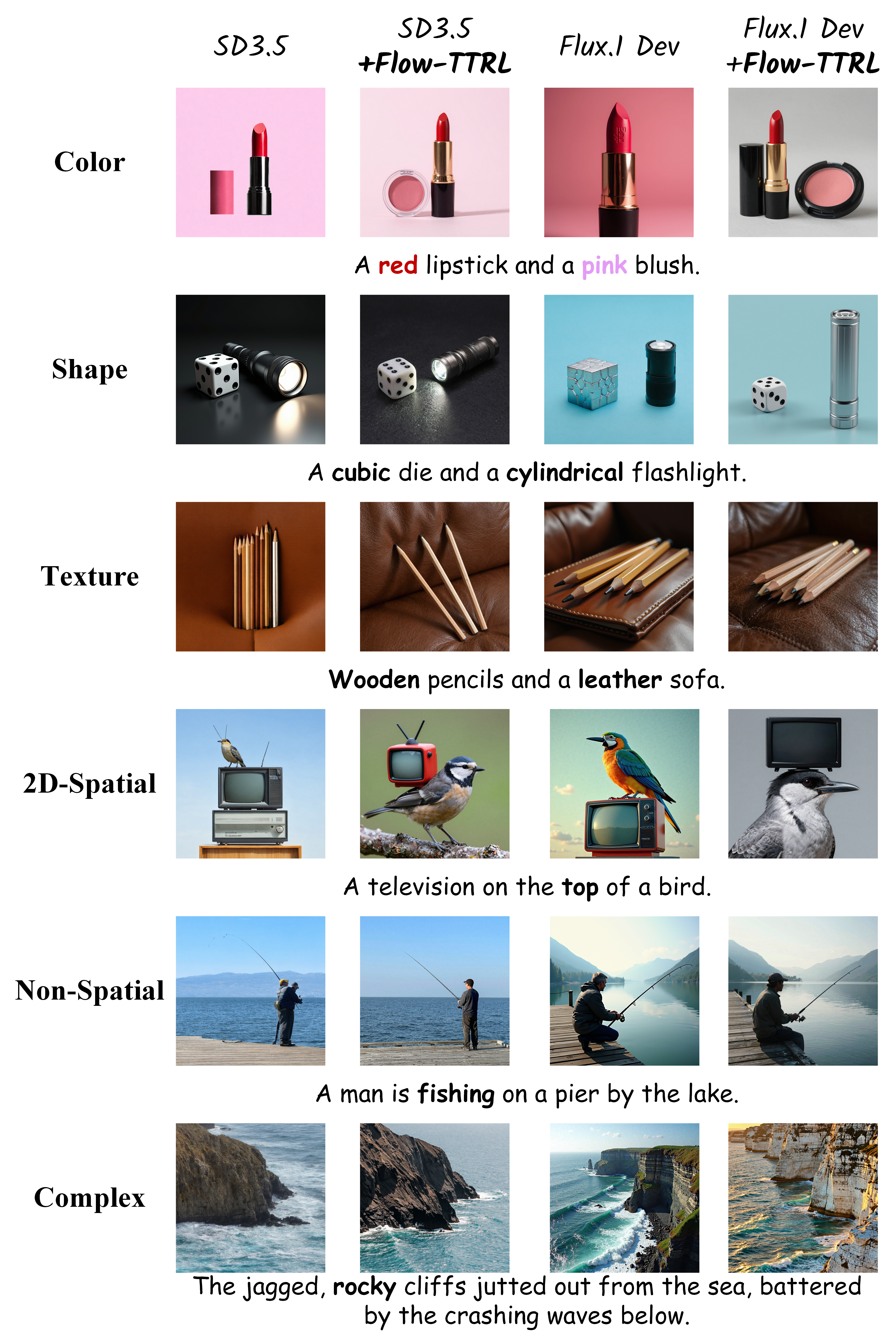
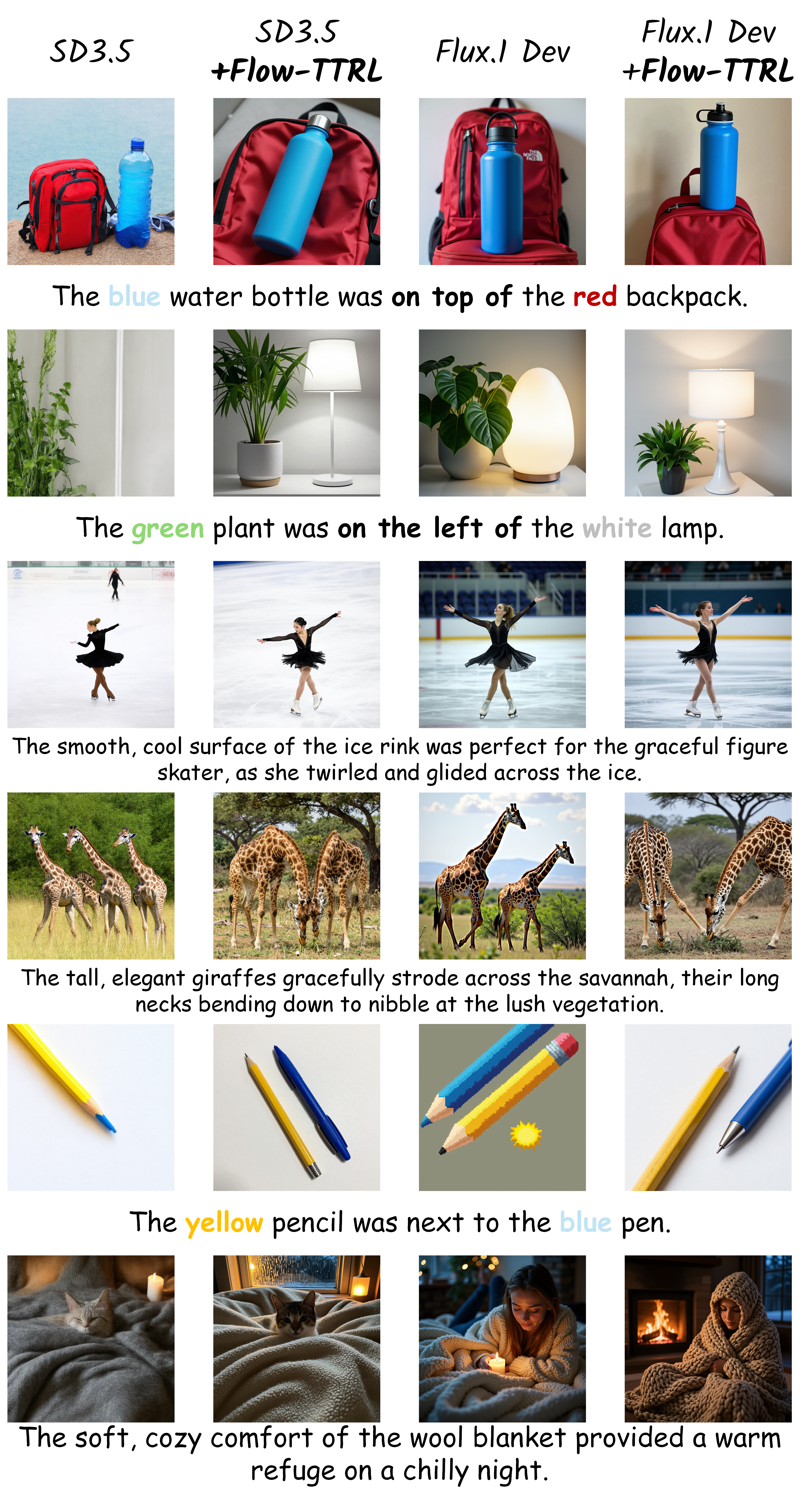
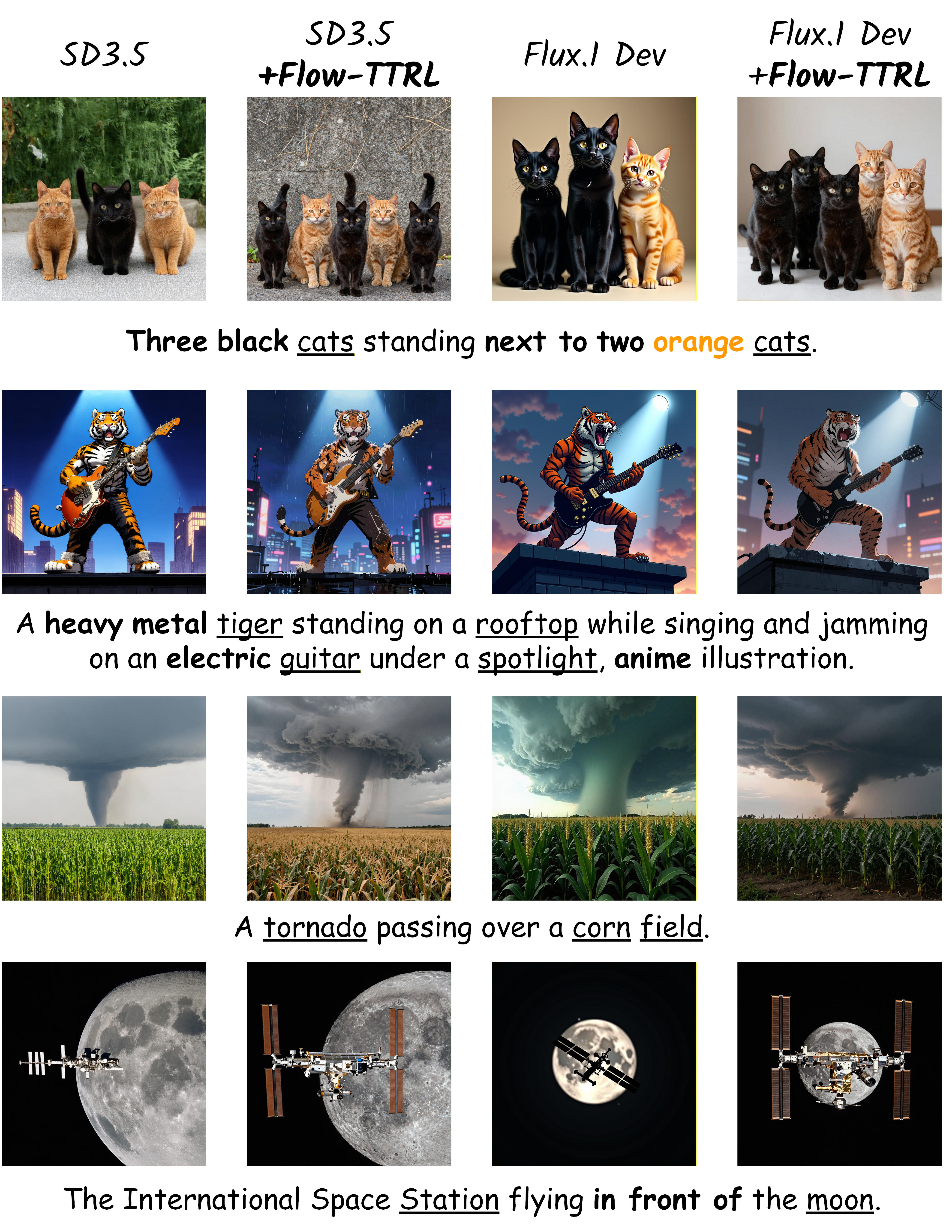
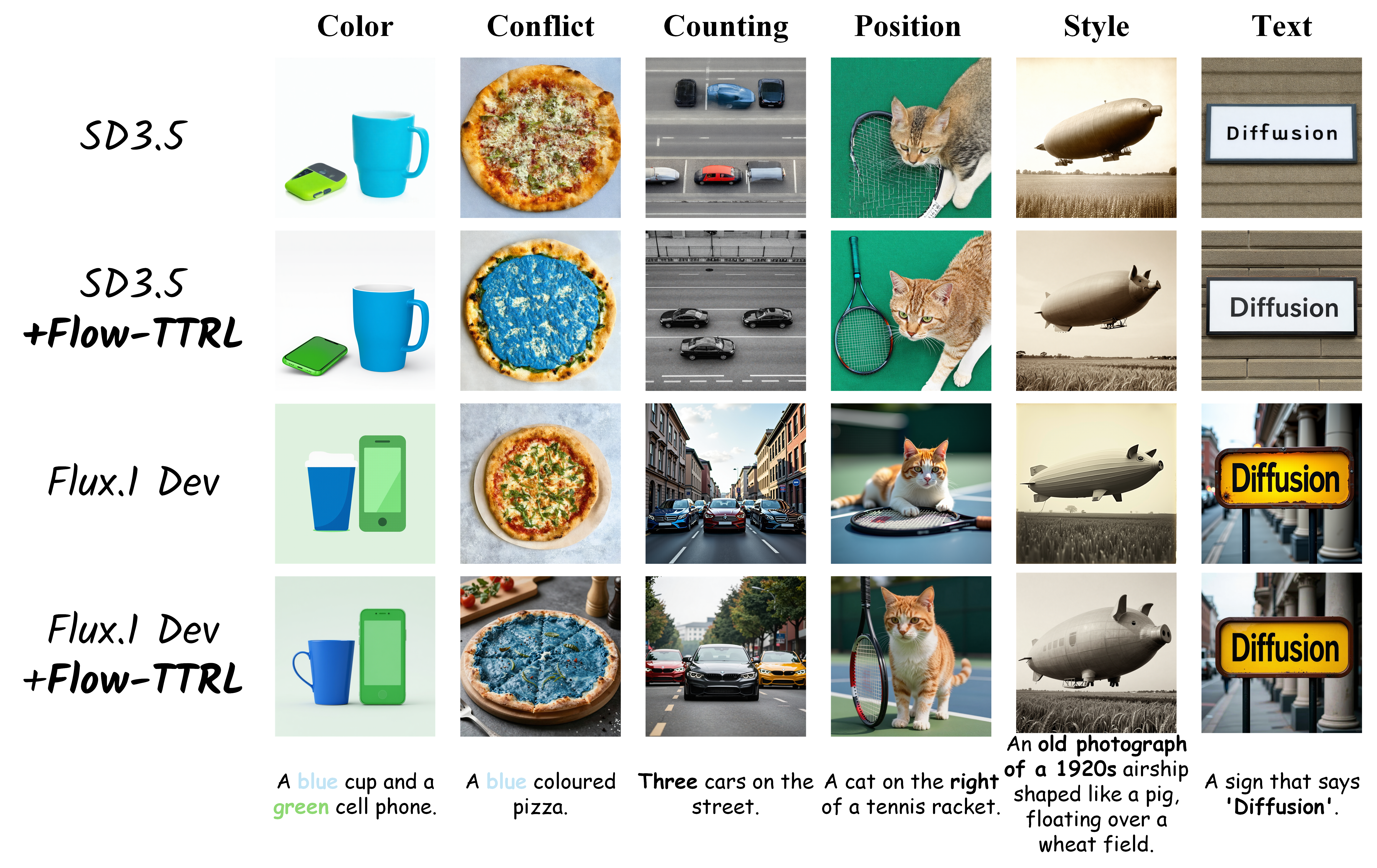
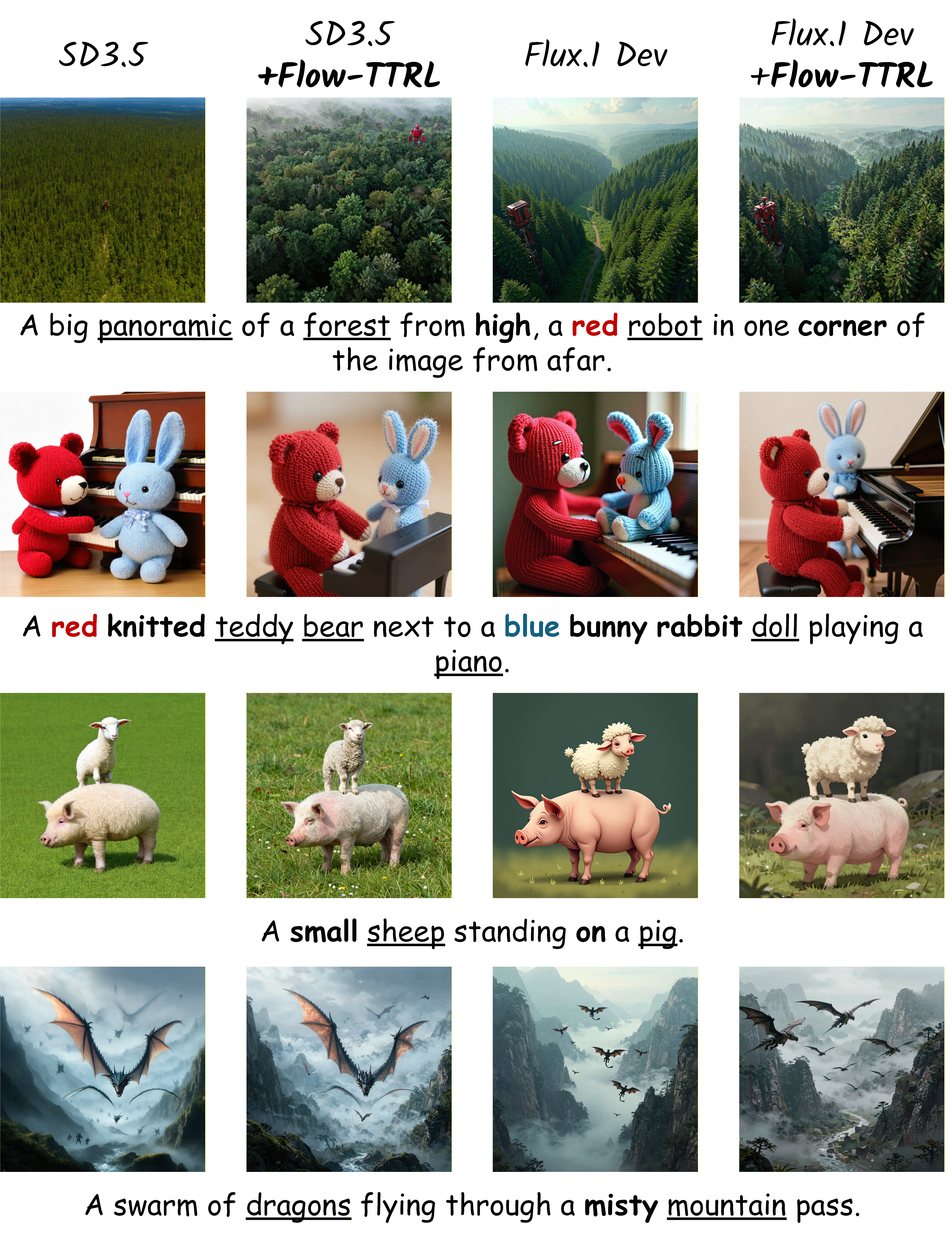
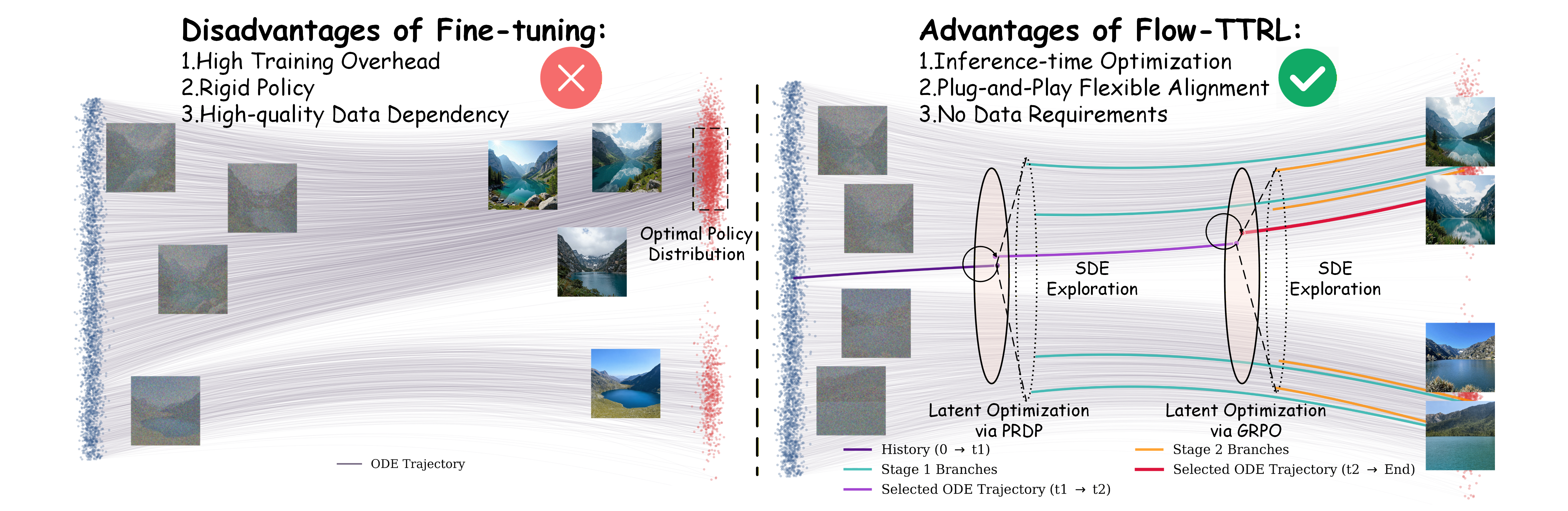
Flow-TTRL is an inference-time optimization framework designed to align flow-matching models with complex human preferences without the need for expensive fine-tuning. By leveraging RL-guided latent search, Flow-TTRL achieves highly competitive results on benchmarks like GenEval and T2I-CompBench, attaining performance comparable to proprietary models and established RL-based fine-tuning methods while consistently bolstering image fidelity and text-alignment.
📖 Introduction
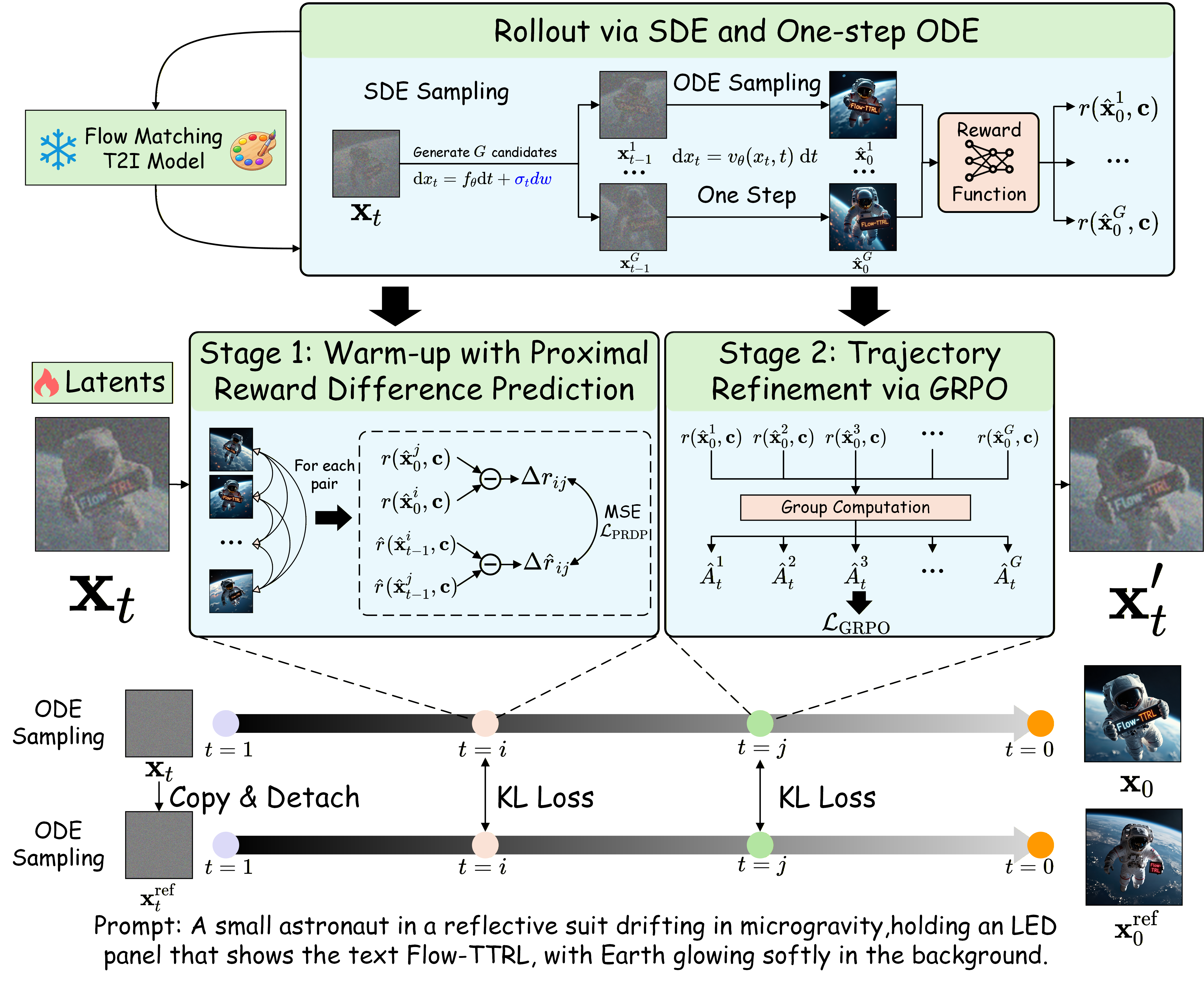
🔧 Method
⚙️ Requirements
Flow-TTRL is tested on Linux with NVIDIA GPUs. While A100/H100 are recommended for optimal inference speed, the framework is compatible with consumer-grade GPUs (e.g., RTX 3090/4090).
Hardware & Memory Optimization
- Recommended: 40GB+ VRAM (for standard FP16 inference).
- 24GB GPU Support: For GPUs with 24GB VRAM, we strongly recommend enabling 8-bit quantization or bitsandbytes to prevent Out-of-Memory (OOM) errors during the iterative DiT forward passes and reward scoring.
Dependencies Installation
# Create a virtual environment
conda create -n flow-ttrl python=3.10
conda activate flow-ttrl

# Install core dependencies
pip install torch==2.6.0 torchvision --index-url https://download.pytorch.org/whl/cu121
pip install xformers==0.0.29.post2
pip install -r requirements.txt
Reward Models
To use the full potential of Flow-TTRL, please ensure the corresponding reward model checkpoints are accessible:
- HPS v2
- ImageReward
- CLIP-score
- AES
- PickScore
- PaddleOCR
The local paths to model weights in the code have been replaced with placeholders (e.g., “xxx”). To run the demos or training scripts, you must manually update these placeholders in the following files with your local directory paths.
🚀 Quick Start
We provide two primary demo scripts to showcase Flow-TTRL across different flow-matching backbones: FLUX.1-dev and Stable Diffusion 3.5 (SD3.5).
Running the Demos
Before running, ensure your environment is activated and you have the necessary reward model checkpoints.
- For FLUX.1-dev:
python demo/flux_sde_demo.py - For Stable Diffusion 3.5:
python demo/sd3_sde_demo.py
Key Variables to Modify
To adapt the generation to your own prompts or to perform test-time calibration, you only need to modify a few key variables within these scripts:
📝 Prompt & Rewards
prompt: The text description you want to generate.score_dict: A dictionary to enable/disable specific reward models and set their weights (e.g.,{"imagereward": 1.0, "hps": 0.5}).
🛠️ Optimization through Parameter Adjustment
To achieve better results for specific prompts or reward objectives, users can adjust the core inference-time parameters mentioned in the paper—such as scale_factor, RL_interation_num, beta, and noise_range. These variables allow for the precise calibration of the reward-guided optimization process at test-time, enabling a better balance between prompt alignment and image fidelity without any model retraining.
📊 Qualitative Results